Overview
Collecting useful SWE tasks is harder than saving a patch and a repository URL. A downstream trajectory is only meaningful when the task is reproducible, understandable, and testable: it needs a clean instruction, a pinned code environment, a bug-introducing change, a ground-truth fix, and tests that can separate solved attempts from unsolved ones.
Curator is the block that turns real GitHub pull requests into verified SWE coding tasks. It collects candidate PRs, filters them with LLM-assisted checks, generates task instructions, builds Harbor compatible task directories, and validates each task. The overall design of Curator is as follows.
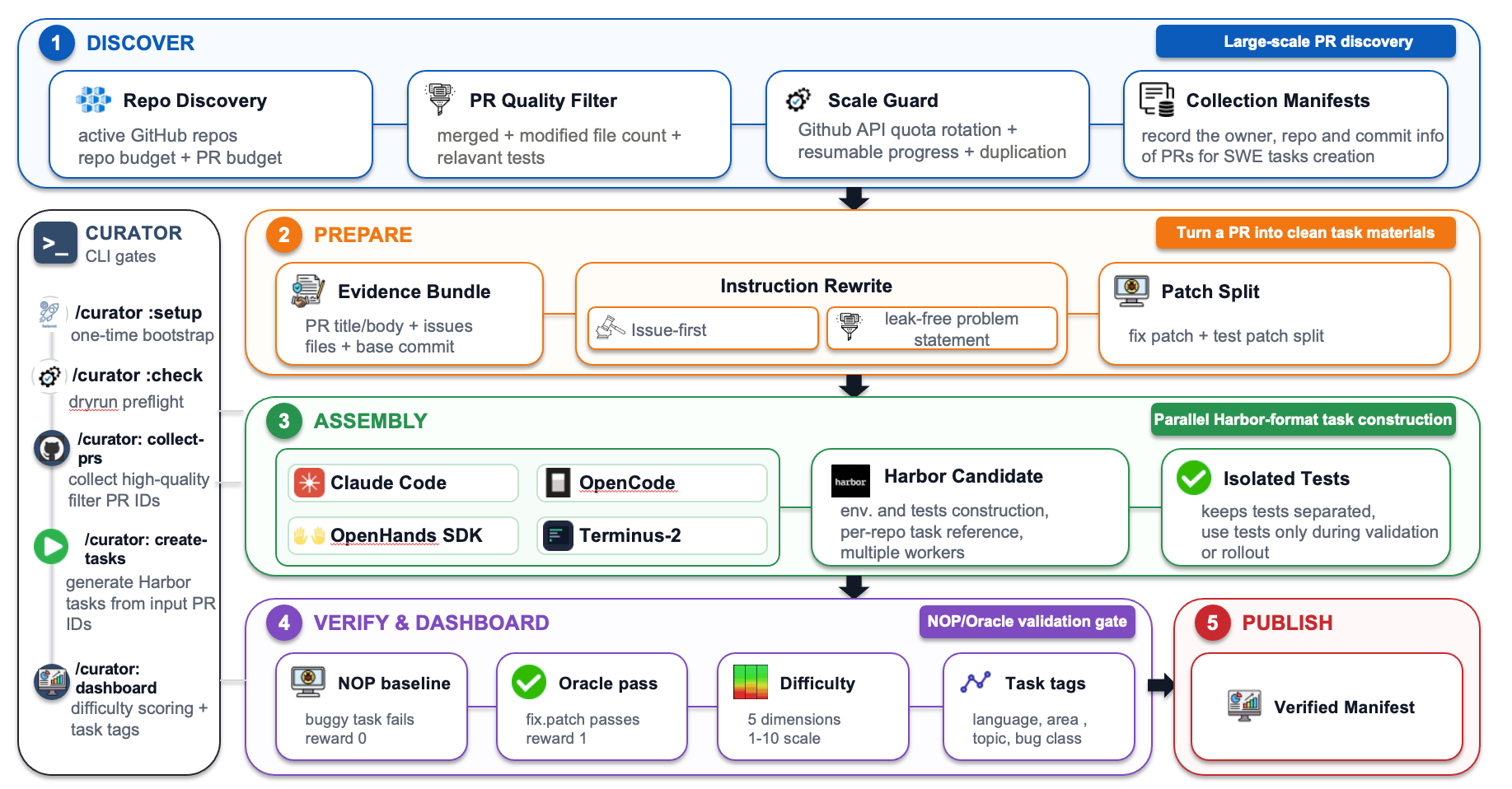
With Curator, you can:
- Collect tasks across Python, JavaScript, TypeScript, Go, C, C++, Java, and Rust.
- Filter noisy PRs before spending rollout or training budget on them.
- Produce Harbor-compatible task directories with Docker environments and tests.
- Run NOP and Oracle validation so downstream blocks receive verifiable tasks.
- Save trusted manifests, batch state, and resume metadata for long-running data construction.
- Attach difficulty scores and task metadata for further analysis.
Where to go next
- Getting Started - set up the block and run a smoke generation
- Design - understand how Curator discovers, builds, verifies, and publishes tasks
- Output Format - understand PR pools, task directories, manifests, logs, and state packages
- Quality Rubrics - compare task difficulty and dataset quality
- Task Tagging - understand task tags and metadata
- Dashboard - monitor dataset size, language coverage, difficulty, tags, and task quality