Design
This page explains what Curator does behind each command. The mechanism follows the workflow in Overview: collect useful pull requests, turn them into Harbor tasks, validate each task with baseline agents, and publish the verified task pool that Tracer can consume.
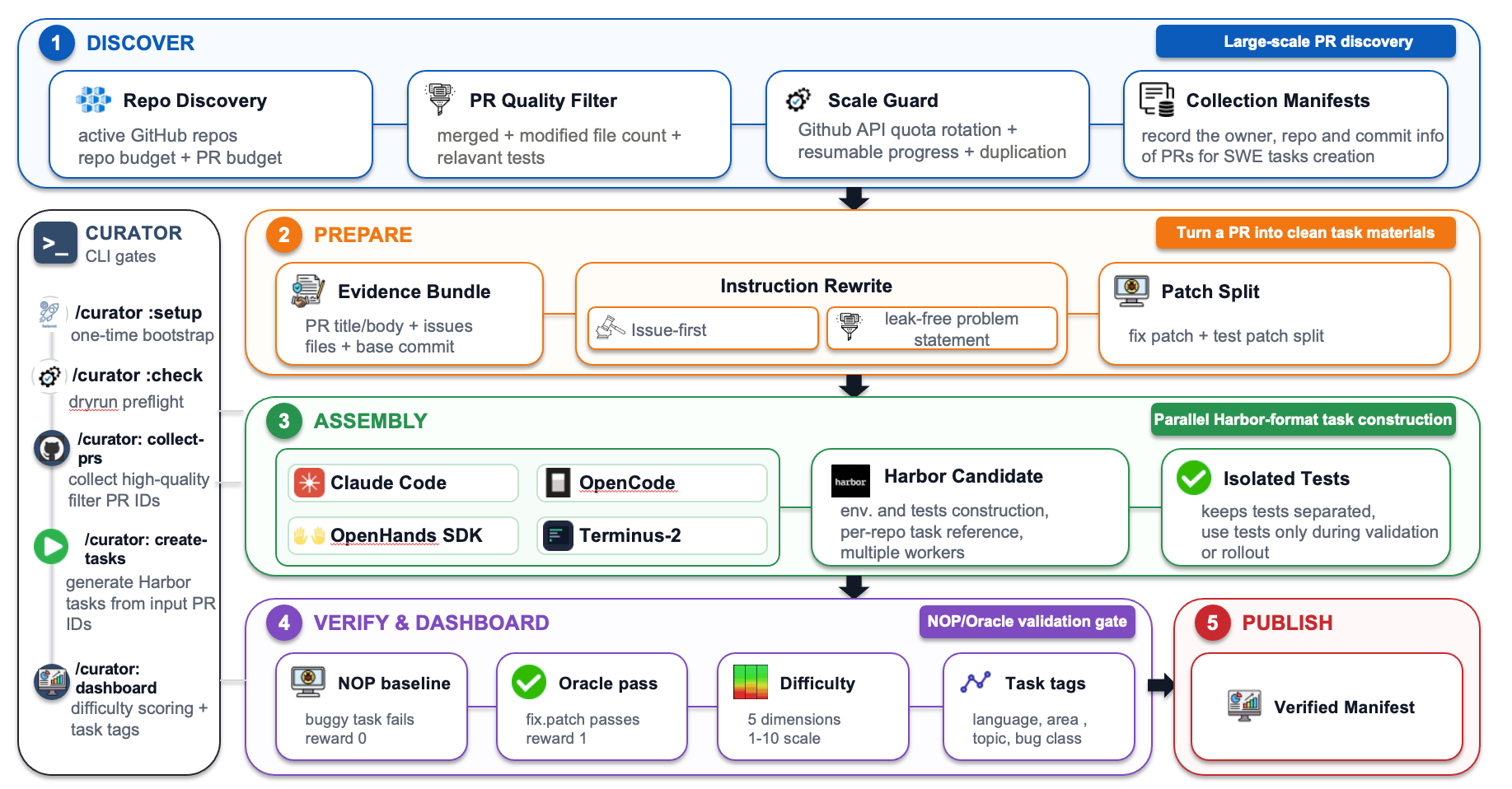
1. Collect PRs
/curator:collect-prs runs scripts/collect_all_bg.sh. The script hydrates
config.yaml, installs the pinned repos/legoflow-curator package if needed, and starts
the LegoFlow Curator collector in the background:
python3 repos/legoflow-curator/tools/collect_prs_wo_image.pyThe collector reads runtime_info.input.pr_collection to decide:
- which languages to search;
- how many repositories and PRs to collect;
- how many PRs to keep from each repository;
- where the language-specific PR id files should land.
The goal is not to collect every PR. Curator is looking for PRs that are small enough, recent enough, and contextualized enough to become reproducible coding tasks.
The output of this stage is a PR pool:
artifacts/collected_prs/
├── python_pr_ids.txt
├── javascript_pr_ids.txt
└── ...
Each line records one candidate PR id. Logs are written under
artifacts/logs/collect_all_<timestamp>.log.
2. Generate Task Candidates
/curator:create-tasks launches the language workers through
scripts/start.sh. The first pass chooses the LLM mode from
runtime_info.input.llm_api.cc_provider_mode:
openai_proxystarts the OpenAI-compatible proxy before generation;nativeuses the native Anthropic path directly.
Then scripts/create_all_bg.sh fans out to the enabled language scripts, such
as scripts/create_py.sh. Each language script reads its own timeout,
concurrency, and task cap through scripts/read_params.py, then calls:
legoflow-curator createFor Python, the handoff is roughly:
legoflow-curator create \
  --input-ids-file artifacts/collected_prs/python_pr_ids.txt \
  --output artifacts/swe_tasks/py-cc \
  --state-dir artifacts/state/legoflow-curator-py \
  --timeout ... \
  --cc-timeout ...
This is the point where noisy PR history becomes a task candidate. LegoFlow Curator pulls the PR context, prepares the repository state, asks the coding model to create a clear task, and separates the materials that should be visible to a solver from the materials used only for validation.
3. Assemble Harbor Tasks
Each generated candidate is written as a Harbor task directory. A typical task looks like this:
artifacts/swe_tasks/py-cc/<task_id>/
├── task.toml
├── instruction.md
├── environment/
│   ├── Dockerfile
│   └── bug.patch
├── solution/
│   ├── fix.patch
│   └── solve.sh
└── tests/
    └── test.sh
The important boundary is simple: instruction.md is what a future agent reads;
solution/ and tests/ are for verification. That keeps the benchmark usable
without leaking the reference fix into the prompt.
4. Validate And Score
Curator does not trust a task just because the directory exists. During
legoflow-curator create, Harbor runs the baseline agents:
- NOP baseline: the buggy task should fail, giving reward
0. - Oracle pass: applying the ground-truth fix should pass, giving reward
1.
Only tasks that pass both checks are appended to:
artifacts/swe_tasks/<lang>-cc/verifiable_tasks.txtCurator also records analysis metadata. Difficulty is computed from task
features and written back into task.toml; tags and categories are used by the
dashboard pages for quality review and slice-level analysis.
5. Publish Verified Tasks
At the end of scripts/start.sh, Curator starts a lightweight aggregator:
python scripts/extract_verified_tasks.pyThe aggregator reads each language's verifiable_tasks.txt, copies only those
verified task directories, and writes a combined manifest:
artifacts/merged_swe_tasks/
├── <task_id>/
├── <task_id>/
└── verifiable_tasks.txt
This merged directory is the clean downstream contract. Tracer should read this pool instead of scanning every intermediate task directory.
Command Gates
The mechanism above is exposed through a small set of plugin skills:
| Command | What it gates |
|---|---|
/curator:setup | Initializes repos/legoflow-curator, installs the environment, and hydrates runtime inputs. |
/curator:check | Validates config, repo pin, GitHub tokens, LLM endpoint, and Docker before work starts. |
/curator:collect-prs | Runs the Discover stage and writes PR pools. |
/curator:create-tasks | Runs Prepare, Assembly, and Verification. |
/curator:dashboard | Scores finished tasks and visualizes dataset tags and difficulty. |
For the shortest runnable path, see Getting Started. For the exact files written by each stage, see Output Format.